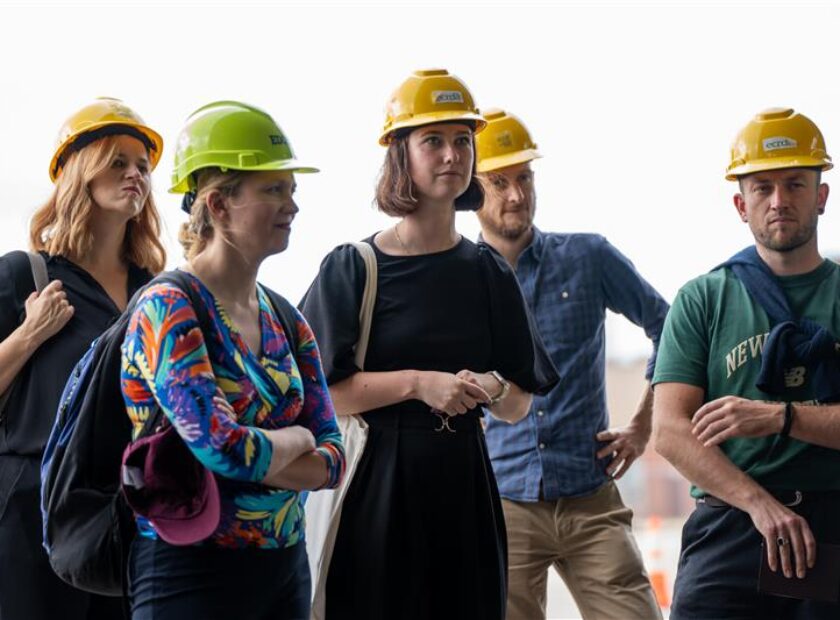
From the disappearing villages of the German Rhineland to the coal country of Appalachian Ohio, the transition away from fossil fuels is as much about democratic resilience as it is about energy. Steve Patterson – mayor of Athens, Ohio and president of the US National League of Cities – explores the “political whiplash” of shifting national policies and the enduring struggle to protect community heritage from the erosion of both physical landscapes and institutional norms.
The date on the chiseled slab set into the cornerstone of the ancient Catholic church in the German village of Keyenberg reads 1662 AD. For centuries the church stood at the center of a small Rhineland farming community – brick farmhouses clustered along narrow lanes, gardens and orchards stretching into fields that had been cultivated by generations of families. But when I visited Keyenberg, the village felt like a place paused between life and disappearance. Windows were boarded up. Weeds pushed through the edges of sidewalks. Tall grasses crept across abandoned yards. Entire rows of homes stood empty, waiting. Keyenberg had been marked for erasure.
For more than sixty years the giant digging machines of Germany’s energy giant RWE had been steadily advancing across the countryside of North Rhine-Westphalia, devouring villages as they carved out the vast Garzweiler open-pit lignite mine. The slow mechanical march had already erased communities such as Reisdorf in 1963, Königshoven in 1983, Otzenrath in 2006, Immerath in 2022, and Lützerath in 2023. Sixteen villages in total were relocated, their houses demolished and their histories forever cut short for the short-sighted and environmentally destructive harvesting of brown coal.
In the heart of the Rhineland, where centuries-old villages once stood amid rolling fields, a quiet erasure unfolded. Homes, churches, and entire communities vanished under the banner of energy security and industrial necessity. Residents were compensated and relocated, but what disappeared could never truly be replaced – the intricate social fabric woven across generations.
A cycle of economic and cultural upheaval
Yet by the time I arrived, something unexpected had happened. After decades of protests – environmental activists living in tree houses in the nearby Hambach Forest, villagers refusing to sell their homes, farmers hosting gatherings and demonstrations in their barns – the advance of the mine had stalled. Germany’s political climate had shifted. The country had begun embracing a transition away from lignite coal toward renewable energy, and villages like Keyenberg were suddenly granted a reprieve.
But it was a reprieve that came too late for many. Eleven communities had already vanished underground. Families who had lived side by side for centuries were scattered into newly built neighborhoods in distant towns – houses modern and comfortable, but severed from the fields, neighbors, and rhythms that once defined their lives.
Standing there, the scene felt strangely familiar to me. Before traveling to Germany, I had served as mayor of a small American city in Appalachian Ohio – Athens, nestled along the coal country and industrial corridors of the Ohio River Valley. My own community had long lived through the same cycle of economic and cultural upheaval that these German villages were now experiencing. For generations, towns across the region were built around coal mines, steel mills, and manufacturing plants. When those industries declined, communities were left searching for a new identity. As mayor, I worked with regional leaders to move past the nostalgia of the old boom-town economy and toward a different future – investing in clean energy initiatives, supporting sustainable economic development, and helping communities imagine prosperity beyond coal. The goal was not to erase the past but to build on it, transforming former industrial regions into places where renewable energy, education, and innovation could drive new growth.
Wondering which future to believe
Yet just as communities began charting that path, the political winds in the United States shifted violently. The climate and energy policies of the Trump administration disrupted years of progress toward a stable transition. International climate commitments were abandoned. Environmental regulations were dismantled. Fossil fuel development was aggressively promoted while renewable initiatives were sidelined.
The result was a political whiplash felt deeply in places like the Ohio River Valley. One year, federal programs encouraged clean-energy investment and economic diversification. The next year, political rhetoric promised the return of coal’s golden age, a promise many knew was economically unrealistic but emotionally powerful in communities shaped by that legacy. And now, with the resurgence of that same political vision in national leadership, the uncertainty has returned once again. Communities trying to rebuild their economies are left wondering which future to believe.
The farmers I met in Keyenberg understood that uncertainty well. One family, among the last still living in the village, had once resigned themselves to the inevitability of relocation. As a final symbolic act of defiance, they had installed solar panels on their farm buildings – even though Germany’s strict historic-preservation rules normally prohibited such changes to traditional farmsteads. They believed their village would soon disappear anyway. The solar panels were their quiet protest.
Instead, the political momentum in Germany suddenly shifted toward a rapid energy transition. The farm – and the village – was spared. Or so it seemed. Global events quickly complicated that certainty. Russia’s invasion of Ukraine forced Germany to rethink its dependence on imported energy. Suddenly, questions arose about whether coal might still be needed to sustain Europe’s industrial economy in the short term. The future of villages like Keyenberg again felt uncertain.
A physical erosion of place and heritage
The same instability now defines American climate policy as well. Each shift in presidential leadership swings the country dramatically between environmental commitment and fossil-fuel revival. Long-term planning becomes nearly impossible when national priorities change every four years. But the consequences of these swings extend beyond energy policy. They ripple outward into democratic institutions and international alliances. Under the Trump administration, many observers argued that the erosion of environmental protections was accompanied by something deeper: a weakening of democratic norms themselves. Executive authority expanded at the expense of institutional checks. Independent agencies faced political pressure. Dissenting voices, including scientists and environmental advocates, were marginalized or dismissed.
At the same time, longstanding relationships with democratic allies were strained. Diplomatic tensions surfaced with countries that had long been close partners of the United States – nations such as Denmark, the United Kingdom, and Spain. International climate cooperation fractured as the United States withdrew from agreements that much of the world viewed as essential to addressing the climate crisis.
These fractures were not merely symbolic. Climate diplomacy has become one of the defining arenas of global cooperation in the twenty-first century. When the United States retreats from that cooperation, it weakens the collective ability of democratic nations to respond to shared challenges. The consequences are visible not only in international negotiations but also in the lives of communities like those in the Rhineland or the Ohio Valley. The displacement of villages for coal mines in Germany represents a physical erosion of place and heritage. The political instability surrounding climate policy in the United States reflects a different kind of erosion – one affecting democratic institutions, public trust, and global partnerships. Both forms of erosion stem from the same underlying struggle: how societies manage the transition away from fossil fuels while protecting communities, democratic values, and international cooperation.
Resistance and renewal
Yet amid these tensions, resistance and renewal continue to emerge. In Germany, activists and local residents fought for decades to defend villages like Lützerath and Keyenberg, transforming them into symbols of the broader struggle against fossil-fuel dependency. Their persistence helped shift national policy toward renewable energy and forced a global conversation about the costs of coal.
In the United States, a new generation of environmental advocates – students, scientists, local leaders, and grassroots organizations – has stepped forward to demand climate action and democratic accountability. Youth-led lawsuits, community energy projects, and regional clean-economy initiatives continue to push forward even when national politics falter.
A hopeful future
During my visit to Keyenberg, I saw glimpses of that hopeful future. Despite years of uncertainty, the village was already imagining a new chapter. Plans were underway to host a major European arts and garden festival in the coming decades – an event expected to bring thousands of visitors to the village’s narrow streets and farm courtyards.
We ate lunch in a refurbished barn and chicken coop that had been transformed into a community gathering space. Residents who remained in the village sat beside newcomers drawn by the area’s emerging story. Farmers who had moved away returned to share meals and conversations. They were doing something quietly remarkable. Instead of allowing the narrative of their community to end with coal, they were writing a new one – built around culture, sustainability, and cooperation.
The lessons of Keyenberg reach far beyond the Rhineland. They remind us that the real cost of energy policy is measured not only in megawatts or economic output, but in communities, histories, and democratic institutions. When progress is defined solely by short-term economic gain, both landscapes and political systems can be sacrificed in the process. The buried villages of Germany and the contested politics of climate policy in the United States are different stories, but they are deeply connected.
Both ask the same question: What kind of future are we willing to build – and what are we willing to lose in the process? The answer will shape not only our energy systems, but the resilience of our communities, the strength of our democracies, and the partnerships between nations that must work together to face the challenges ahead.


Related Posts