Policy, Pride and Partnership – U.S. Industrial Heartlands Study Tour Fall 2025
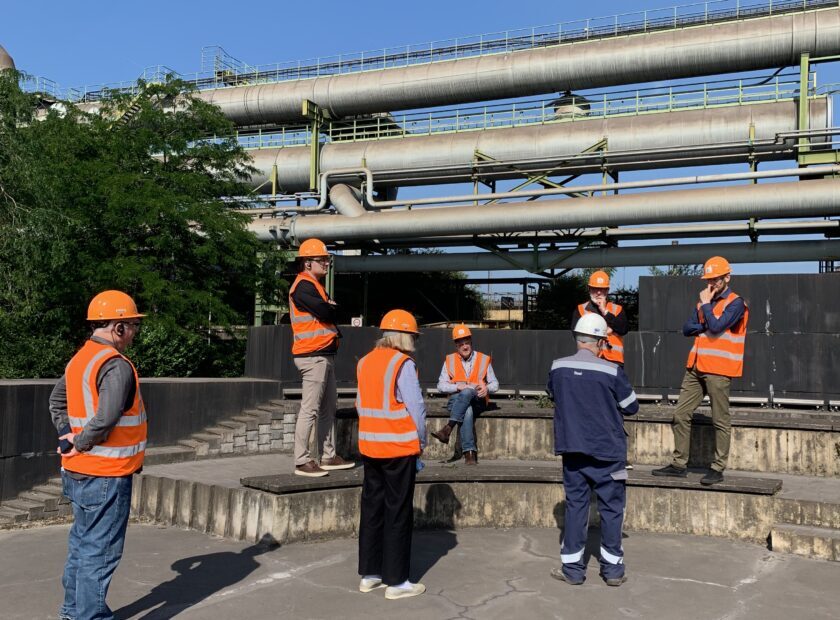
Following our initial transatlantic study tour of the U.S. Midwest in 2024, our fellow group of young changemakers reconvened for a comparative analysis of Germany’s former industrial engine rooms in September 2025. From the lignite mines of the Rhenish Revier to the steel mills of the Ruhr Valley, and eastward to the transforming Lusatian landscapes of Cottbus and Görlitz, our fellows engaged with the actors navigating the complex interplay of socio-ecological change, industrial renewal, and democratic backlash.
On the ground, we encountered a stark reality check: The blueprints for a green economy are ready, yet the political and social foundation needed to build them is shaking.
Here are our three takeaways from the road.
Policy: Transformation is not the problem per se; planning uncertainty is
Through our insightful dialogues with industry experts and regional developers, we found that companies and workers are not dragging their feet on the green transformation – see the steel plants in Duisburg or the “Net Zero Valley” in Lusatia. However, the current backtracking on goals for renewables, e-mobility, and green hydrogen puts planning and investment for future production at risk, fuelling widespread frustration.
Our meeting with Duisburg Business Innovation made this tangible. For a city that has been in a state of continuous structural transformation for 55 years, change itself is not the enemy. The critical bottleneck is the inconsistency of federal energy policy. For a hub striving to position itself as a leading location of the hydrogen economy, this lack of a reliable trajectory hinders the ability to reconnect residents to new economic opportunities.
One trade union expert on Eastern Germany put the stakes in concrete terms: “Investment cycles in heavy industry span thirty years, while political cycles last only four.” Without a bipartisan consensus on energy infrastructure that survives legislative terms, the industrial heartlands cannot attract the capital commitment needed for renewal.
Pride: Economic investment is futile without social recognition
Both in the US and Germany, historic levels of investments in industrial heartlands – such as the Inflation Reduction Act and the Strukturstärkungsgesetz – have not halted the rise of right-wing extremism. While travelling we noted: Economic regeneration alone is insufficient if policy neglects the decisive need for public recognition of past labour in coal and heavy industry as well as sites of remembrances. Especially in Eastern Germany, where the post-unification transformation is still ongoing, future change cannot succeed without acknowledging past efforts and ruptures.
We found a powerful model in the work of project fellow Milad Tabesch and his initiative Ruhrpott für Europa. By framing democratic values through the lens of local pride – where “being from the Ruhr Valley” implies a shared heritage of hard work and diversity – the initiative bridges the gap between disaffected youth and democratic institutions.
This sense of inclusive identity was echoed in the Rhenish Revier at Cafe No. 5, a community hub in a village originally slated to fall victim to the open-cast mine. By preserving this historic space, local residents are maintaining agency over their own future rather than surrendering to erasure.
But belonging takes constant work. As we were reminded at Commoning Cottbus, a participatory urban lab to bridge the gap between local university students and the wider community: “Our democratic way of life is not a boat you just get into; everyone needs to paddle.” Sustainable change and democratic resilience require that citizens view themselves as proud architects of their future and their communities, rather than passive subjects of policy.
Partnership: Subnational diplomacy offers untapped potential
When transatlantic ties at the federal level are at rock bottom, subnational diplomacy between states and cities is imperative – a point strongly reiterated during our visit to the German Ministry for Economic Affairs and Energy. Across the Atlantic, local and regional leaders are managing impressive revitalisation efforts with considerable successes. There’s still ample room to deepen knowledge exchange, economic partnerships and diplomatic ties – as for instance discussed on climate partnerships between German Federal States and U.S. States with officials of the Federal Foreign Office.
We found that actors on the ground are often far ahead of national discourse. The exchange between Duisburg and Pittsburgh highlights how cities with shared “industrial DNA” can accelerate knowledge transfer, bypassing national gridlock. In the German East, Görlitz exemplifies this approach through its EU-funded Triland cooperation project with its Polish neighbours. Connecting these local innovators across the Atlantic or EU borders offers great potential for pooling resources and exchanging best practices.
Outlook
The transformation of the industrial heartlands is not merely an economic adjustment; it is a test of democratic resilience. We advanced these findings at our transatlantic conference on heartland revitalisation in December. Additionally, our project fellows published two policy papers based on this study tour, aiming to translate local insights into actionable, place-based recommendations.

Related Posts

Axel Ruppert
9. May 2025